

Hasanah Forum 2025: Philanthropy that Listens
Manisha Shah, Asia Philanthropy Partner
Kuala Lumpur, 14–15 August 2025 – The Hasanah Forum, hosted by Yayasan Hasanah in Kuala Lumpur, brought together leaders from across Asia and beyond to reflect on the role of philanthropy in a rapidly changing world. Over two days of keynotes and panel discussions, the Forum underscored both Malaysia’s growing leadership in the philanthropic space and the unique ways in which Asia is shaping its own identity in global giving.
The gathering was framed by its central theme: “Philanthropy that Listens: Bridging Intent with Intervention.” The phrase captured a recurring message across the sessions – philanthropy must move beyond pledges and policy ambition, and focus instead on translating intent into impact by engaging deeply with communities.
Malaysia’s Role in Philanthropy
The Forum coincided with Yayasan Hasanah’s 10th anniversary. Established as the impact-based foundation of Khazanah Nasional Berhad, Malaysia’s sovereign wealth fund, YH has evolved from a disaster relief cash assistance program to a systems-change driven foundation promoting social equity. Built on a corpus of RM 2 billion, it now disburses RM 220 million annually (about USD 50 million) and has worked with 674 partners, each representing voices from the ground.
“Hasanah listens to its partners as representatives of the communities we serve,” said Chairman Tan Sri Md Noor Yosef in his opening remarks. “This is what allows intent to translate into real impact.”
Malaysia’s Minister of Finance, Datuk Seri Amir Hamzah, reinforced the government’s alignment with philanthropic approaches. He announced an allocation of RM 100 million through five partners for disaster relief and community development, as part of Malaysia’s national framework built on the principle of Madani – care, compassion, prosperity, sustainability, and respect.
Global Challenges and Regional Responsibilities
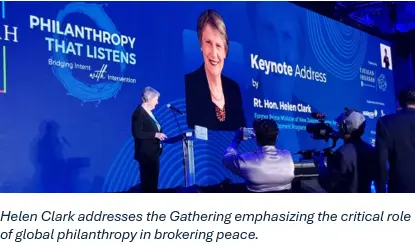
The international dimension was set by Helen Clark, former Prime Minister of New Zealand and former Administrator of the UNDP. She pointed to the existential challenges of our time – climate change, artificial intelligence, conflicts, and environmental degradation – all of which demand stronger global governance.
Clark also underscored the urgency of humanitarian crises, citing her visit to the Egypt–Palestine border where she witnessed aid blocked from reaching those in need. Her message was clear: while philanthropy cannot replace government, it can act as a critical catalyst by supporting systems thinking, piloting innovation, and connecting across sectors.
This is especially vital in Asia, which hosts half of the world’s poor households. “Asia’s progress,” Clark stressed, “is essential for global progress and stability.”
Persistent Challenges in Malaysia
Several sessions highlighted structural barriers in Malaysia’s philanthropic ecosystem:
- Persistent inequality: Even if Malaysia attains high-income status, more than half the population will remain below the global average, with regional disparities and low upward mobility from the bottom quartile.
- Unequal opportunities: Early childhood conditions, family background, and declining returns to higher education limit social mobility.
- Labour market constraints: Underemployment and limited availability of high-skilled jobs reduce the payoff of education.
- Policy–practice gap: Ambitious policies often fail to translate into ground-level change, creating a critical space for philanthropy to intervene.
- Tax policies: Current incentives encourage annual spending rather than long-term strategic giving.
- Fragmentation in heritage sector: With arts and heritage divided across six ministries, accountability is weak and philanthropy lacks a clear entry point.
These challenges reinforced the Forum’s theme: philanthropy must listen to lived realities and act in the space between intent and intervention.
Key Themes from the Forum
Partnerships and Systems Change
Philanthropy, participants agreed, must go beyond cash assistance and address systemic barriers. Community organizations often outperform government in implementation, while cross-border collaboration is essential as many of Asia’s challenges – from climate change to disability inclusion – transcend national boundaries.
The discussion also drew contrasts between Malaysia’s Yayasan Hasanah and Singapore’s Temasek Foundation. While YH is funded by a sovereign wealth corpus, Temasek operates as an independent investment company, channeling profits into social innovation. Both highlight different but complementary approaches to aligning resources with social outcomes.
Measuring What Matters
Speakers stressed the difficulties of designing impact measurement frameworks that are politically acceptable, organizationally feasible, and practically usable. The tension between measuring what is easy versus what matters remains unresolved. In Asia, where cultural norms discourage open discussions of failure, building genuine feedback loops with communities is particularly important.
Community-Driven Change
Several initiatives highlighted the transformative power of community ownership:
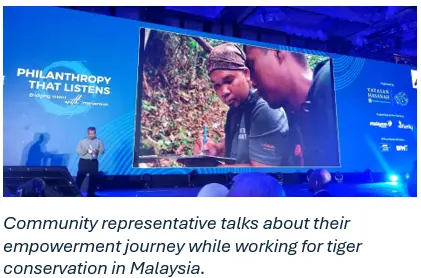
- Rimau: tiger conservation through community rangers and local education funds.
- MareCet: protecting Malaysia’s marine heritage with the involvement of fishing communities.
- Arus Academy: improving teacher wellbeing to address student trauma and enhance learning.
-
Nippon Foundation: training thousands of disabled people across Asia for skilled jobs.
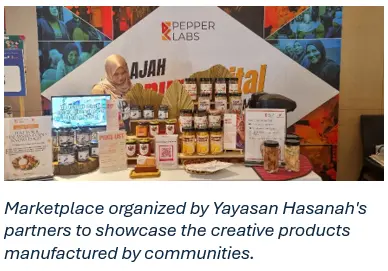
These efforts illustrated philanthropy’s ability to act as a bridge – supporting local solutions, building trust, and addressing issues that governments alone cannot.
Social Finance
Malaysia’s religious giving, particularly Zakat (~USD 400 million annually), remains underutilized as an economic instrument. Experts argued for unlocking its potential in supporting social enterprises, alongside stronger governance of Waqf institutions. Collaboration across borders and blended finance approaches were seen as crucial to scaling solutions where markets fall short.
The Asian Philanthropy Mosaic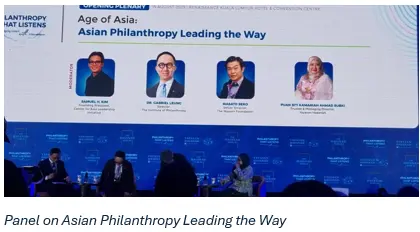
The closing sessions situated these discussions within a broader regional context. “There is no one Asian way – Asia is a mosaic,” noted one panelist. From India’s decade-old CSR law to Indonesia’s Waqf models, from Singapore’s growing ecosystem to Japan and South Korea’s mature foundations, Asia’s diversity is its strength.
Speakers reminded the audience of Asia’s history as maritime states – open, trading, and welcoming diversity. That openness explains the region’s rich cultural heritage but also its late arrival to modern development. With 60% of the world’s population and a rapidly ageing demographic, Asia must now design new social models rather than replicate those of the West.
Looking Ahead
The Hasanah Forum 2024 made clear that Asian philanthropy is stepping into its own voice. By listening deeply, grounding itself in community realities, and bridging the gap between intent and intervention, philanthropy in the region is poised to complement government, catalyze innovation, and strengthen resilience.
As Malaysia positions itself as a hub for regional collaboration, the Forum’s message was unmistakable: philanthropy that listens is philanthropy that lasts.