
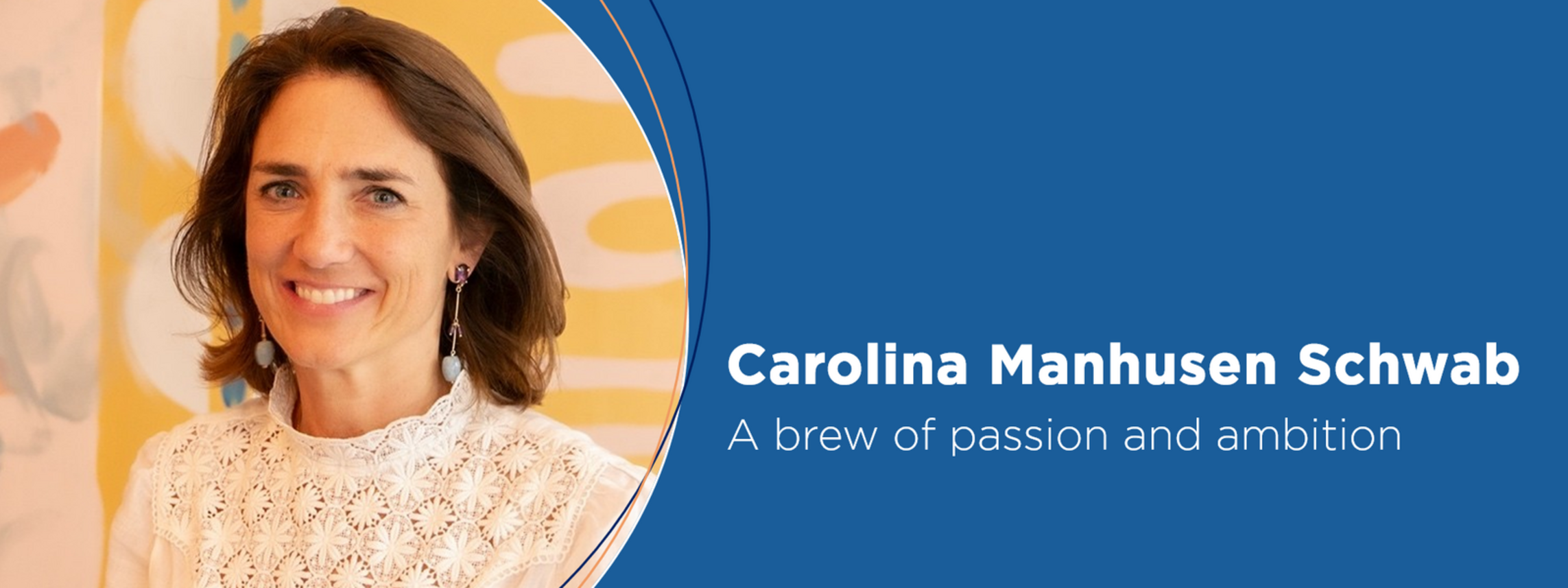
GPC Member Profile: Carolina Manhusen Schwab
In the newest edition of the GPC Member Profile, we are thrilled to showcase the work of Carolina Manhusen Schwab, a passionate champion for ocean restoration and social entrepreneurship worldwide. Of Swedish and Argentinian descent, she has two daughters and lives in Madrid with her husband and their rescue cats, dogs, and chickens.
Carolina’s story is one of drive, dedication, and a strong belief in the power of people. She emphasizes that ‘we all have a role to play in protecting the ocean.’ As the co-founder of the Ocean Born Foundation with her husband Martin, she has been instrumental in raising awareness and funds to accelerate initiatives and awareness needed to fight climate change. Protecting the ocean targets 25% of the solution to the ongoing climate crisis. Through the foundation, Carolina highlights the connectivity between all ecosystems and how they have to work together for our planet to thrive.
Her commitment to protecting our world extends beyond the Ocean Born Foundation. She not only sits on the board of the SeaLegacy and WOW Foundations, but has spent the last fourteen years as the Vice Chair of the Board of Trustees of mothers2mothers. This further showcases her impressive dedication to a diverse range of causes, including climate change, gender issues, healthcare, and immigrant integration.
Join us as Carolina shares her insights on the urgent need for climate action and the inspiring initiatives she supports.
You have a background in Economics, having worked at the Inter-American Development Bank and at Merrill Lynch. How did the transition from your career in banking to social entrepreneurship and philanthropy happen?
I have always been interested in these topics. I studied economics, then specialized in macroeconomics, and my second master’s degree was in Development Studies. My first job was at the Inter-American Development Bank, around the time when they were preparing for the United Nation’s Women Conference in 1995, in Beijing. During that period, I began to understand social injustices and vulnerabilities through a gender lens.
In the early 90s, the Grameen Bank had had tremendous success around micro credit loans, and regional development banks were then setting up similar programs that, of course, had a very strong gender lens. For me, that was a wonderful place to be, because it blended ‘hard’ economics and social issues that were close to my heart.
My background in banking was an incredibly powerful training center, which allowed me to sharpen skills like attention to detail. You know, today, it’s quite funny to be in the climate space, but in fact I was in the Energy and Power team at Merrill Lynch back then. But I did feel far removed from what I really wanted to do, so I jumped back into the social sector.
And how did climate action and especially ocean conservation get into that?
Everyone has their own climate story; I think we’re all aware that we have a problem. For me, it’s something I’ve always been very concerned about. But it’s true that I was also naively hopeful that governments would fix these big problems. I was a kid in the 80s, when the Montreal Protocol was signed. Today, however, these problems have worsened. And it’s not like we don’t know how to fix them – we just seem to lack the political will to do it. I just like to remind people: the more we delay it, the harder it will be. I despair when people talk about ‘our goals for 2050’. We need to think about the present.
One specific thing that struck me was an IPCC (Intergovernmental Panel on Climate Change) report released five years ago. As an economist, if you follow the numbers, they’re quite dire. How bad do the numbers need to get before we all start feeling that we need to do something? When we talk about climate, we forget that we’re talking about life, and what permits life on this planet to exist. It no longer really matters what your topics of interest are – if we disregard the biosphere, everything comes crashing down. For example, working in the health space, if you start having droughts in one area and the population starts moving, you cannot keep up with providing a good health care service for people that are already very vulnerable.
About 71% of the Earth’s surface is water, and the ocean plays a major role in climate action. Right now, this whole ecosystem is breaking down. We need $175 billion every single year to restore the ocean back to health for it to have its equilibrium. We’re now spending $10 – that’s a $165 billion shortfall. If you look at funding going to the SDGs, SDG 14 (life below water) gets less than 1%. So, investing in ocean health is a very strategic decision to make. But I always remind people that everything is connected. What happens in the ocean affects the atmosphere and the land, and vice versa.
The Ocean Born Foundation was established in 2021 envisioning ‘a healthy blue planet for the long-term benefit of all life on Earth’. Could you give us an overview of the ways in which you work to fulfill this vision?
There are incredible people working towards ocean protection, but many of them spend too much time raising funds to be able to do the actual work. So, what we do is fund them, for whatever time they need to establish their operation, and just let these bright people focus on what they do well. We don’t have any projects of our own, we just want to support the people out there doing the work and take away their pressure from funding.
Also, we have seeded the capital for four business units, which sit legally within the Ocean Born Foundation.
The idea behind this is that we all have a role to play in protecting the oceans, and we wanted to create a platform where everyone felt that they could be a part of the solution by supporting these businesses. Of course, this is a Euro-centric vision (we are based in Madrid), and I know that other locations and contexts require different approaches. Our aim is to bring to the market products and services that consumers would buy anyway, with the lowest negative impact.
Our consumption choices matter. We make hundreds of choices a week that we really don’t think about, because we’re busy, and we’ve got it on automatic pilot. Changing human behavior is hard, and at Ocean Born we need to make you super aware of these choices. My most basic example is Ocean Beer, which is one of the business units in the Foundation. So, helping our mission can be as easy as every Friday night, instead of ordering whatever your normal beer is, have an Ocean Beer. And you know that the profit from that goes to supporting scientists working on the recovery of ocean. Without a doubt, if part of this problem has been collective consumption, part of the solution is there too.
In simple terms, all our business units must do three things: raise awareness about better, intentional consumption choices, bring these to market with the lowest negative impact to the planet possible, and generate money – 100% of profits generate funding for the people who are working on the solutions.
The mission of restoring the ocean is a crucial, but ambitious task. Does the scale of the problems you’re trying to address with Ocean Born sometimes frighten you or cause you to question what you can do?
It terrifies me. And I think this is why it’s very hard to get people to engage. I’m not going to sugarcoat that for a second: we’re playing with our own ecosystem, with our own lives, with the lives of future generations.
However, do I question it? Never. Because if we get our work right, our reward is this beautiful, blue, miracle planet that has all this wonderful life, and where everything is interconnected.
I find inspiration in everything. And if you’re working toward that inspiration, there’s nothing to question. Surely, what we’re fighting for is clean air, clean water – basic things. But we’re also fighting for kinder, more equitable systems. I mean, we have done harder things. This requires willpower, and a bit of focus, but we can attain this. And we can’t afford to question it.
We also need to remind people that we are not living in the worst present today, thanks to people who have worked in the past and whose names we don’t know. Our present today could have been so much worse. So, no one should feel hopeless.
What would you say is your proudest moment from Ocean Born Foundation so far?
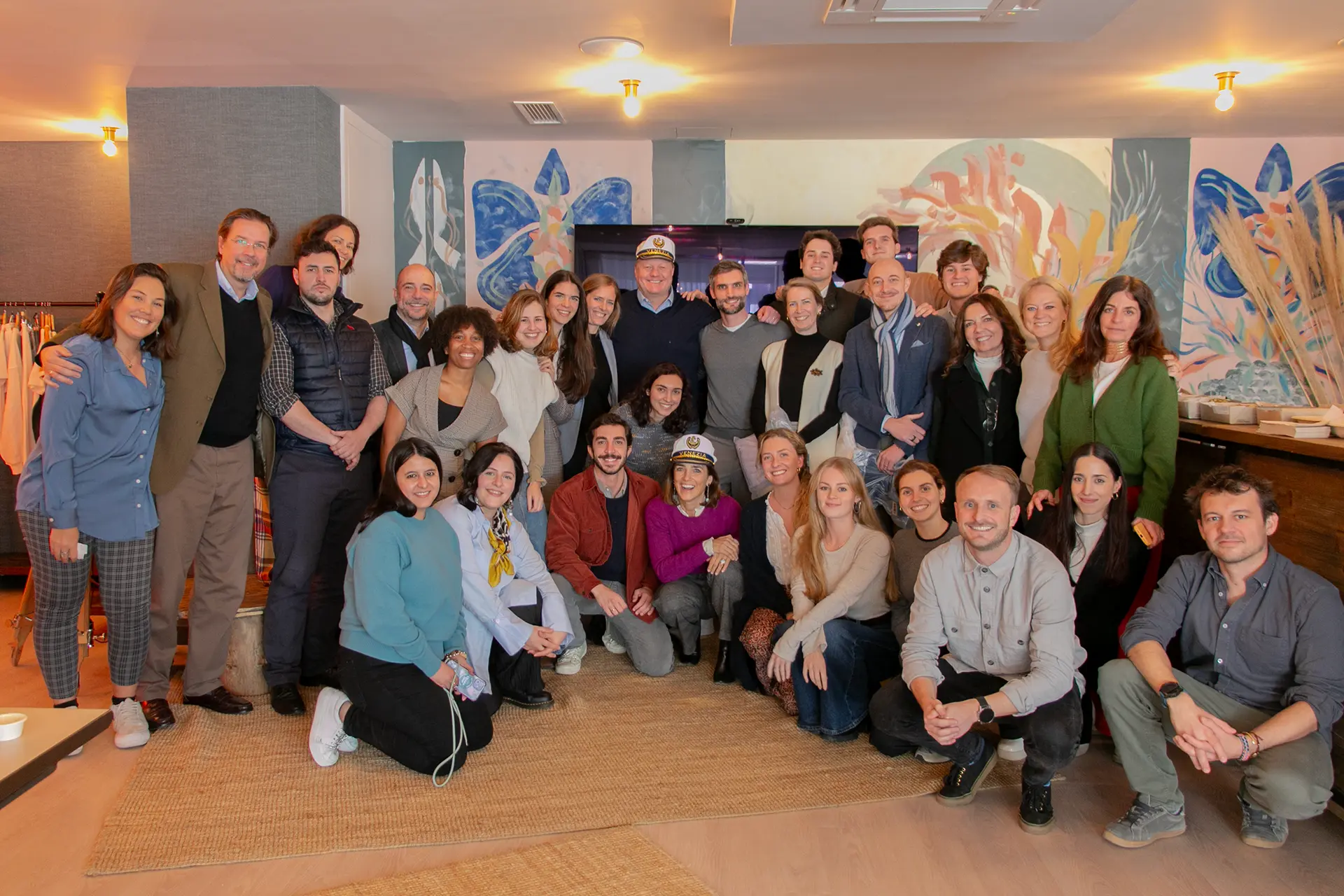
I would have to say it’s the team we’ve put together. We’ve had so many ‘pinch-me moments.’ But really, day to day, the fact that you have an idea, and 40 other people believe in that idea, and come and help you accelerate is amazing. Not to mention all our pro bono partners – the fact that they are powering us means that we can do everything faster, so that we can then accelerate the ones that are working on the solutions. And this is a wonderful, virtuous chain.
There are amazing people everywhere; you just have to unlock the opportunity for them to be able to take part. The climate community has embraced us so wonderfully, and we’re part of this enormous network. It fills me with tremendous pride that we can be part of that.
Your commitment to the protection of the ocean extends beyond OBF. For instance, you sit on the board of Sea Legacy, which uses the power of media and storytelling to amplify ocean solutions. Can you tell us a bit about this initiative?
Sea Legacy is an extraordinary organization and was one of the early inspirations for me at Ocean Born. The Foundation is only three and a half years old, and from the beginning, I had immense respect for Sea Legacy’s founders — Paul Nicklen, Cristina Mittermeier, and Andy Mann. My husband reached out to them with our idea, and to our amazement, they responded positively. Cristina Mittermeier encouraged us to pursue our vision, which gave us the courage to move forward.
I’ve learned a lot from their journey. Being asked to sit on their board was an honor for me. Although we face different challenges, funding is a common issue for both organizations. Sea Legacy stands out because of its incredible team. The founders have complementary skills that create a powerful synergy, allowing them to achieve remarkable results. They are scientists who use their expertise to drive significant change. They understand that people protect what they love, so they make sure to foster a deep connection with the ocean through their storytelling. Sea Legacy excels at identifying opportunities for political change, such as the creation of Marine Protected Areas (MPAs). Their dedication and impact are truly remarkable.
You are also passionate about gender issues, as exemplified by your involvement in mothers2mothers and WOW Foundations – the first one aims to improve healthcare in African countries, while the latter focuses on professionally integrating immigrants in Sweden. Was there a specific motivation for you to work with these causes?
I would go back to people. I think if you find the right group of people and believe they can get the job done, those are the people you need to support and work with. With mothers2mothers, I knew nothing about healthcare and nothing about Africa when I started. But it was clear that those people were going to achieve whatever they decided to do.
Mothers2mothers was created in 2001 to combat the AIDS epidemic in sub-Saharan Africa, and the orphans it creates. A major issue was children being born with HIV, which is preventable. To tackle this challenge, they developed a scalable peer model, creating a group of women who had been through the program themselves. These women could reassure newly diagnosed mothers, saying, ‘I was in your shoes three years ago, and this is how we’re going to help you.’ With this simple but powerful model, mothers2mothers has consistently achieved a mother-to-child transmission rate of under 1%, far surpassing the UN target of under 5%.
WOW Foundations is very different but equally impactful. Sweden has been generous in accepting immigrants from conflict areas, but the integration policies have been suboptimal, creating parallel societies that are detrimental to all. WOW Foundations uses a peer model to help immigrants integrate by matching them with Swedish individuals who assist them in finding work and navigating the system. This approach not only provides dignity but also helps them contribute to society.
What are the plans for the future of your philanthropic endeavors?
Our primary goal is to bring hope back to the conversation and make climate action engaging and appealing. We need to raise substantial funds to secure a beautiful planet and a promising future for all. Implementing the Sustainable Development Goals (SDGs) seriously is crucial; they are not just colorful icons at the UN, but represent significant, well-researched targets.
A major focus for us is the 30 by 30 agenda, which aims to protect 30% of the planet’s land and ocean by 2030. We’re already pushing this goal and considering an even more ambitious 50 by 50 target. This effort is critical, and we’re gearing up for the UN Ocean Conference next year in Nice, which promises to be a pivotal event. Scaling our efforts is vital, and we’re always looking for partners to help us achieve greater impact. We’re building a lot of momentum, and it’s an exciting time.
Our big, audacious goal is to raise 250 million euros for impact investing in planetary health within the growth space. By investing exclusively in projects that are inherently impactful and scaling them, we can achieve both significant scale and impact. There are many innovators out there who just need better funding, and we aim to support them.